


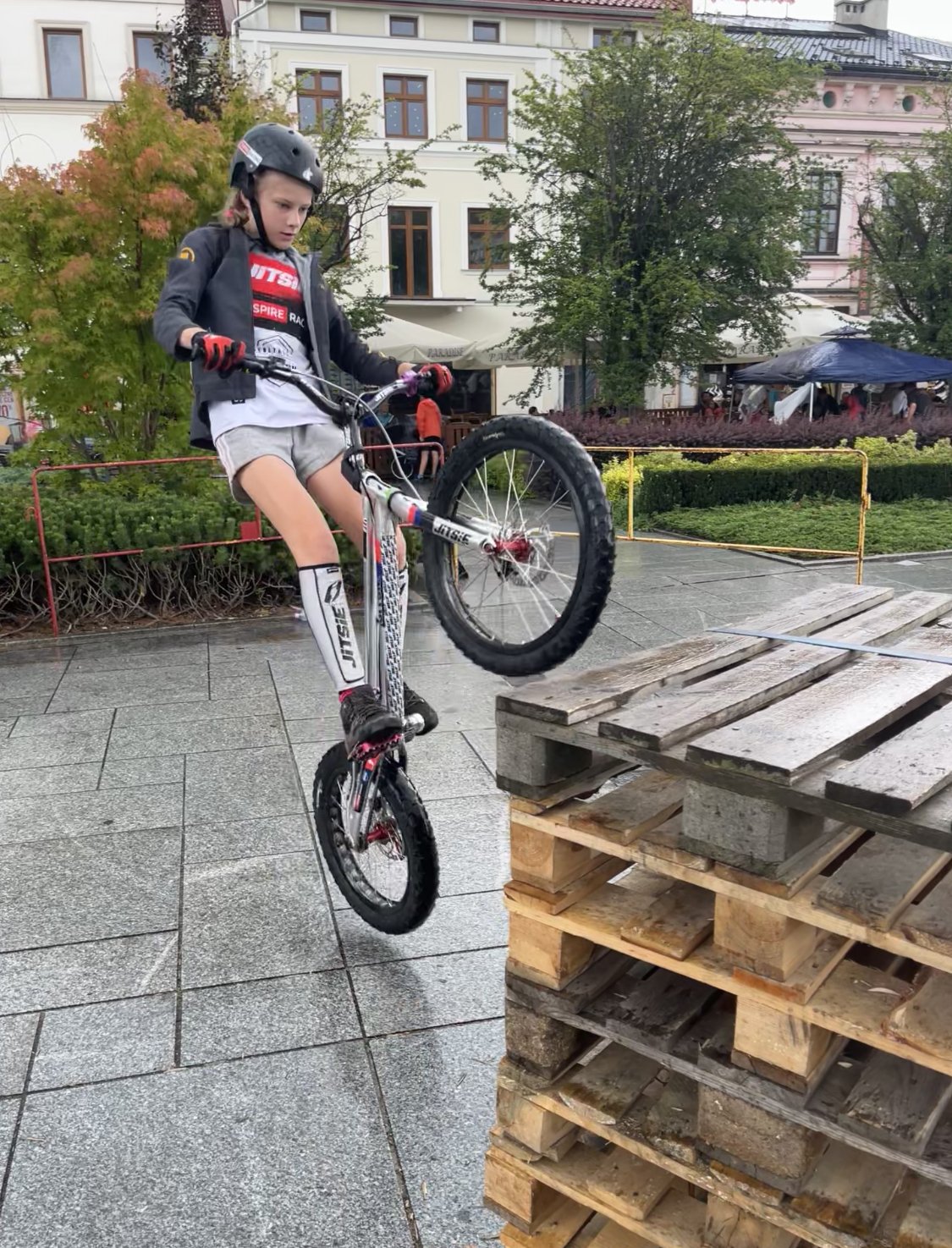
Daisy Craig riding trials in Poland in 2022, at her first UCI Trials World Youth Games.
Ask a trials rider how high they can sidehop and they’ll probably tell you about their best one. Fair enough. We remember the first time we make a wall that’s beaten us for weeks. But if I’m interested in how well someone rides, I’d like to know something else. How high can you sidehop first time, put the rear tyre where you intended and hold the landing?
There can be quite a gap between those two heights. Somewhere in that gap is the reason I think skill is a rider’s greatest asset. If you’ve already made the wall, you know that, on at least one occasion, you could produce enough force to get up it. What happened on the other nine attempts? And if you’ve only got a few hours to train this week, where are you most likely to find an improvement?
What changes when you put a bike under the rider?
A study of 20 elite bike trials riders and 13 amateurs gives us a good place to start. The researchers tested the riders’ jumping ability on the ground, then tested them on the bike. One of the bike tests was a sidehop over an elastic bar. The elite group jumped higher in both settings, but the size of the difference is interesting. The researchers reported a 28% advantage in the off-bike countermovement jump and a 45% advantage in the on-bike vertical jump. Bike trials field study and results
It would be tempting to subtract one number from the other and call the difference technique. The study can’t tell us that. It compared riders who were already at different levels, and clearing an elastic bar gives you a different problem from landing on a ledge. What it does show is that the elite riders were good jumpers before they picked up their bikes, and their advantage grew when they had to coordinate the jump with a bicycle. Both observations matter when deciding how to train. Development of specific tests in bike trials riders and relationship with jumping ability
Think about a sidehop from the rear wheel. You might generate plenty of height and still leave the bike short of the ledge. You might get the tyre exactly where you want it, only for your hips to carry on travelling sideways. The first attempt feels like you need to jump harder. The second feels like you need to land better. Yet either problem may have started before the tyre left the ground, in how you loaded the bike and the direction you gave that first push. More effort could send you further past the mark you’ve just missed.
What the muscles are learning
When I talk about muscular control, I mean being able to produce the force a particular movement needs, in the right direction, at the right time, and then ease off when it has done its job. Take your grip on the bars. You need enough tension to control the bike as you load and move it. Holding that same tension through your forearms and shoulders while you’re still finding your balance can make a familiar ledge feel like hard work before you’ve even taken off.
There’s a physiological reason an unfamiliar movement can feel so expensive. One way the nervous system can steady a joint is to contract muscles on opposite sides of it together. That gives you stiffness, which can be useful when you’re uncertain what is about to happen. It also takes energy. In experiments where people learnt to control a reaching movement under unfamiliar conditions, researchers measured changes in muscle activity as well as the energy people used. With practice, the movement became less costly. In a related experiment, the researchers also found that opposing muscles spent less effort contracting together as participants adapted. These were arm movements in a laboratory, but they offer a plausible explanation for something riders recognise: a move can start to feel easier before you have any reason to think you’ve become stronger. Huang, Kram and Ahmed on the energy cost of learning · Research on muscle coordination and metabolic cost
The nervous system also learns the particular sequence you practise. In a study by Karni and colleagues, adults practised a sequence of finger movements over several weeks. They became faster and more accurate at the practised sequence, alongside changes in how their motor cortex responded when they performed it. A sidehop asks much more of the body, but the specificity is relevant. A rider has to learn how the push through the pedals, movement at the bars and movement of the hips fit together on the bike. Being strong enough to perform each part leaves plenty to learn about putting them together. Karni and colleagues on practice and the motor cortex
You can feel this on a modest ledge. On one attempt, you pull hard, clear it comfortably and need two little hops to settle. On another, the tyre arrives in much the same place, your body arrives with it and you can stay there. Which one would you like to be able to repeat at the end of a section? They count as the same height in your training diary. They make quite different demands on your hands and legs.
Why I’d spend more time below maximum height
A sidehop is an explosive movement. When I say low-intensity volume, I mean spending plenty of time on obstacles comfortably within your capacity. The take-off can still be sharp. What you’ve reduced is the physical demand of each attempt, so you can make more attempts while you still have the control to change something.
Put a chalk mark on a broad, low ledge and try to land the rear tyre on it. Give yourself a few goes from the same starting position. Notice whether you tend to miss short, go past it or hit the mark and drift off balance. Now change one thing. Move your starting position a little, or see what happens when you give the bike slightly less sideways movement. At that height you can afford to underdo it on purpose. That’s a useful experience for a rider whose usual response to a miss is to put more into the next one. You get to feel how much is enough.
This gives volume a purpose. If you land on the mark and hold it three times out of ten, then come back next week and manage eight, something worth having has changed. Try a different ledge of similar height. Can you find the movement again without spending half the session working up to it? That matters more to me than adding another ten repetitions after your forearms have tightened and every attempt has started to feel the same.
There’s some experimental support for leaving room before fatigue, although the limits of the evidence matter. Branscheidt and colleagues fatigued participants’ hand muscles before they practised a task requiring precise control of force. On that task, fatigue interfered with learning, and some of the disadvantage persisted when the participants returned to practise fresh. My coaching inference is that if the purpose of today’s ride is to refine timing and muscular control, I’d give that work some of the best minutes of the session. Branscheidt and colleagues on fatigue and motor learning
I’d still ride higher obstacles. Near your limit, you find out whether the timing you’ve developed holds up when the movement has to be quicker and more forceful. A handful of fresh attempts can tell you what to work on next. If the tyre clears the edge but you repeatedly carry on sideways, you have something specific to take back to a lower ledge. If you’re consistently in balance, putting the bike where you intend and reaching the limit of the height you can generate, you have a different problem.
Where the gym earns its time
That last rider has a good reason to consider strength work. The trials study found a strong relationship between several off-bike jump tests and jumping performance on the bike. A stronger, more explosive rider has more physical capacity to draw on, and for someone who already controls the movement well, that may be exactly what’s missing. The study didn’t establish how much riding time anyone should exchange for gym time. That decision depends on what is limiting the individual rider. Bike trials jumping study
If time allows, I like a ride followed by some gym work. Use the ride to practise the skill while you’re fresh. Then give the gym session a specific job. A squat gives you a way to develop leg strength. A jump gives you a way to practise producing force quickly. Over time, you can see whether those improvements carry over to the bike. A bigger squat is useful information. So is a stronger rider who still lands the rear wheel in a different place on every attempt.
For most developing riders with limited time, I’d expect the biggest gains to come from riding. That’s a coaching judgement, and the sidehop makes it fairly easy to test. Pick a height you can already make, mark the landing and count how often you can put the tyre there and stay balanced without a correction hop. Give yourself a few weeks of regular practice below your limit, then try it again. If the wall you used to make once on a good day becomes the wall you can ride first time, that’s athletic progress, even if it hasn’t grown an inch.