


By Billy Craig
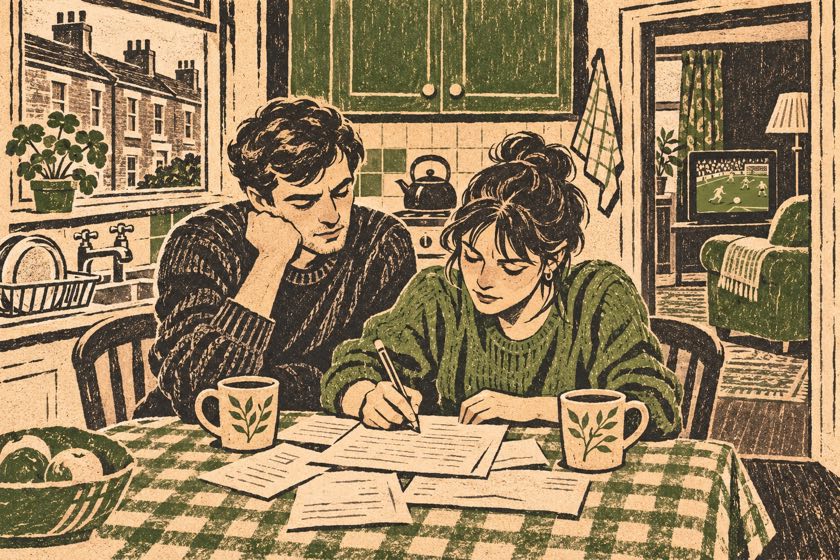
If a young couple spend Saturday watching football, put a few quid on the result and decide they can’t afford to start a family, which part of that story would we call a sign of decline? The football and the bet are easy targets. I’d be more interested in the conversation they had about the family.
People have been looking for signs of civilisational decline in other people’s pleasures for a very long time. The Romans had their games. We have a bookmaker in our pockets, a running commentary on the private lives of strangers and the option to have almost anything delivered before we’ve quite decided whether we want it. There’s enough material there for a decent argument about decadence. What bothers me is how quickly the argument moves from describing what people do to passing judgement on the sort of people they’ve become.
I think there’s a step missing. Before asking why a generation seems so willing to live for the moment, it might be worth asking what happened to the future it was supposed to be working towards.
Does an empire have a sell-by date?
In 1976, Sir John Glubb published The Fate of Empires. Looking across a selection of great powers, he proposed six ages through which they tended to pass. Pioneers were followed by conquerors, merchants, an affluent society, an age of intellect and, eventually, decadence. He reckoned the whole affair generally lasted about ten generations, or 250 years. It’s an arresting number in 2026, two and a half centuries after the American Declaration of Independence. John Glubb, The Fate of Empires
Try applying that clock to Rome, though. Glubb counted the Republic and the Empire separately. A family living through the reign of Augustus could have kept the same house, worked the same land and paid some of the same debts while, by Glubb’s reckoning, one civilisation finished its allotted span and another began. And why start America’s clock with independence? It became a global superpower considerably later. You can get quite different answers to the question of how long an empire lasts by changing what you mean by an empire. Glubb, The Fate of Empires
What I find more interesting in Glubb is his observation about prestige. One generation honours the people who take risks to secure its future. Several generations later, a society wealthy enough to take that security for granted may reserve its greatest rewards for athletes, entertainers and celebrities. I’m quite happy to watch someone exceptional at their sport. I am curious, though, about a culture in which a teenager can name a footballer’s weekly wage, the car he drives and who he’s seeing, yet has little idea what the person who designed the local flood defences does for a living. What picture of a worthwhile adult life have we given that teenager? Glubb, The Fate of Empires
What happens after you win?
For the Roman historian Sallust, the turning point came when Rome destroyed Carthage in 146 BC. While Carthage remained a credible threat, rich and poor Romans had a reason to cooperate. Once it had gone, old contests over land, office and money could be pursued with fewer restraints. In Sallust’s account, ordinary citizens still supplied the soldiers, while a small circle of powerful men divided up the spoils. He probably gave earlier Rome rather more credit for harmony than it deserved. Even so, he put his finger on a distinction that survives the centuries. A country can win a contest from which many of its own people gain very little. Sallust, The War with Jugurtha, chapter 41
There’s a modern echo in the end of the Cold War. During the space race, the United States was willing to fund years of research, tolerate expensive failures and train people to solve problems that had no immediate commercial return. Soviet competition gave that spending a political urgency. When the Soviet Union dissolved in 1991, the West could declare victory. A harder question followed. What did it now want to do with the extraordinary scientific, industrial and financial capacity it had assembled?
It would be convenient to date our present difficulties to that moment. The cracks were visible much earlier. American survey data show trust in the federal government falling steeply between the 1960s and the late 1970s, across the years of Vietnam and Watergate. Those people hadn’t been made cynical by social media. They had watched officials make claims on television and had subsequently been given good reasons to doubt them. When people complain today that the public has lost faith in institutions, I’d like to hear the second half of the discussion. What experience would give somebody grounds to put their faith back? Pew Research Center, historical polling on trust in government
A successful company in a struggling town
Imagine a factory that has had a good year. Its directors could replace ageing equipment, train apprentices, raise wages, develop a new product or return money to shareholders. Each choice has beneficiaries. Each also expresses a view about how far into the future the company is prepared to look.
One change in the US came in 1982, when the securities regulator adopted Rule 10b-18. It gave companies a legal safe harbour against certain market-manipulation claims when they bought back their own shares under specified conditions. A buyback can make sense when a business has spare cash and few worthwhile investments. It also reduces the number of shares outstanding, which can improve earnings per share even if the company makes exactly the same profit. A board can point to an improved figure. An apprentice needs an employer willing to make a commitment that may take years to pay off. US Securities and Exchange Commission, guidance on share repurchases
Global trade widened the gap between the fortunes of a company, its customers and the town where it once made things. A washing machine could become cheaper at the same time as the work that enabled somebody to buy one disappeared. Economists David Autor, David Dorn and Gordon Hanson studied American communities exposed to rising competition from Chinese imports. In the places hardest hit, depressed wages and labour-force participation persisted for at least a decade. Ten years looks like an adjustment period on a graph. It’s most of a childhood if your parent lost that job. Autor, Dorn and Hanson, The China Shock
The internet made it easier to sell into a town without employing many people there. International corporate structures also make it possible to book profits far from the places where customers, workers and public infrastructure helped produce them. The OECD estimates that profit shifting and related practices cost governments between US$100 billion and US$240 billion in annual revenue worldwide. Think of a high street where parcels arrive daily, the shops stand empty and the council struggles to maintain the road the vans drive down. Plenty of economic activity is taking place. Where does its value settle, and who picks up the bill? OECD, base erosion and profit shifting
The circus came home
Juvenal’s phrase bread and circuses usually comes out when someone wants to complain about the hours people spend watching sport or television. His original passage is sharper than that. The Roman satirist begins with the vote. The people he ridicules had once helped choose those who held public office. By his day, he says, their ambitions had narrowed to food and the games. Read in that order, it raises an awkward possibility. Perhaps the crowd became absorbed in the spectacle partly because the decisions that mattered had already moved beyond its reach. Juvenal, Satire X, lines 77–81
The year 2007 makes for a curious dividing line. Apple introduced the iPhone in January. By the end of the year, the United States had entered the recession associated with the financial crisis. Put yourself in the position of someone coming of age around then. Over the following years, the technology in their hand gave them extraordinary control over what to watch, buy, publish or play. Meanwhile, the financial decisions that shaped the availability of jobs, mortgages and credit proved to be things even the people in charge struggled to understand. You could acquire a worldwide audience from your bedroom and still have no idea when you’d be able to move out of it. Apple, original iPhone announcement · Federal Reserve History, the Great Recession
The Colosseum at least required you to go to the Colosseum. Today the match, the odds, the pundit’s verdict and the argument about the verdict can all reach you before you get out of bed. A subscription buys access to the game. Another buys access to the personality talking about the game. An influencer can earn a living turning an ordinary day into something worth watching. On adult-content platforms, a monthly payment can buy a sense of personal access to somebody whose business depends on maintaining that feeling for many subscribers at once. The customers have different reasons for being there. The businesses share an interest in getting them to come back tomorrow.
What does the screen displace? One experiment gives a more interesting answer than the usual instruction to put your phone down. Researchers paid some Facebook users to deactivate their accounts for four weeks. On average, those users spent more time socialising with friends and family and reported better wellbeing. They also knew less about current affairs. Anyone who has opened an app to check what’s happening locally and surfaced half an hour later in an argument between strangers will recognise the difficulty. The noticeboard, newspaper, pub and fruit machine are all behind the same piece of glass. Allcott and colleagues, The Welfare Effects of Social Media
The fruit machine deserves a moment of its own. There’s a practical difference between putting a fiver on Saturday’s result and being offered fresh odds throughout the match, especially when there’s another game starting straight afterwards. Researchers studying the legalisation of online sports betting across US states found that access reduced household savings, with financially stretched households particularly exposed. That finding gives us something firmer to discuss than whether earlier generations had better self-control. We changed how often a bet could be offered, where it could be placed and how quickly someone could place the next one. Why would we expect the consequences to stay the same? Baker and colleagues, Gambling Away Stability
Who can afford the next generation?
Long before anyone worried about young people and their phones, Aristotle was considering the dwindling number of Spartan citizens. He described a society whose land had accumulated in relatively few hands. Full citizens were expected to contribute to common meals. A man who could no longer afford his contribution could lose his political standing. Sparta prided itself on the strength of its citizen body while maintaining property arrangements that steadily narrowed the pool of people who could belong to it. And that distinction matters. A fall in the number of recognised citizens tells us something different from a count of every child born in Spartan territory. Aristotle, Politics, Book II
A modern version of the contradiction can sit quietly across a Sunday dinner table. The parents have seen their house rise in value by more than they earned that year. Their daughter has worked, saved and ended the same year further from buying a home. Her parents remember the sacrifices they made for a deposit. She can make those same sacrifices and arrive at a different result. Both generations have done their sums correctly. Now imagine how the familiar question about grandchildren sounds from her side of the table.
Across the OECD, the average fertility rate fell from 3.3 children per woman in 1960 to 1.5 in 2022. South Korea recorded 0.78 in 2022. Japan’s ageing population brings the practical consequences into view, including who will care for older people as the generations following them get smaller. The United States also sits below replacement fertility. Those countries differ in housing, working hours, childcare, migration and expectations of mothers and fathers. Treating the figures as a single international measure of moral decline would tell us very little about any of them. OECD, Society at a Glance 2024
We could also ask people what they want. In a survey across 14 countries, the UN Population Fund and YouGov found that 39 per cent of respondents said financial constraints had affected, or would affect, their ability to have their desired number of children. Others cited housing, job insecurity and worries about the future. Some people positively want a life without children. Others would love a second child and can’t see how to cover another nursery bill. A national fertility rate records the outcome of both decisions and tells you almost nothing about the difference between them. UNFPA, State of World Population 2025
What would decline look like from the inside?
I suspect most of us imagine civilisational decline as an event we’d recognise. The government falls, the currency fails, the gates come down. A wealthy modern country has plenty of ways to postpone that sort of reckoning. A government can borrow to keep services running. A central bank can keep credit flowing through a crisis. A subsidy can keep a factory open. Technology can help a smaller workforce produce more. Used well, those measures buy time to repair things. They can also buy time in which a difficult decision passes from one government, board or generation to the next.
From inside that society, the experience might be surprisingly ordinary. The pension payment arrives. The stock market has a good year. The phone in your pocket does things that would have seemed extraordinary to your grandparents. Your parents’ house is worth a fortune. Meanwhile, the bus your mum used to catch to the shops now runs twice a day, your employer has stopped taking on apprentices and your grown-up children need your help with the rent. Which of those facts would you put in the headline about how the country is doing?
That leaves a harder question than whether Rome resembles America, or whether an empire’s 250 years are up. A sudden crisis forces decisions, often at dreadful human cost. A slow deterioration gives a country the chance to change course, though the people with the greatest power to do so may be among the last to feel anything going wrong. If you own the house, hold the shares and can buy privately what used to be provided locally, the arrangements may continue to look quite successful for years. Someone twenty-five years younger can live on the same street and reach a very different verdict.
I’d go back to that couple watching the football. Suppose they switch it off at half-time, delete the betting app and spend the afternoon looking at rental listings, childcare fees and what each could earn if the other dropped a day at work. By tea time they may have done everything a critic of modern distractions could reasonably ask of them. They’ve put the phone down, paid attention and thought seriously about the future. If the figures still don’t add up, what exactly would we like them to do differently?